
SWELL · full technical record
SWELL: the full technical record
Everything behind the SWELL page, for readers who want the detail: the science, every simulation result (failures included), every claim and its status, the full parts list with safety ratings, the lab safety tables with their safety data sheets, and the cheapest-first test plan. Nothing here has been built; every result is from simulation or a price page.
Science
The three ideas behind SWELL
The project's design rule: chemistry does the resolution work, so the optics can stay modest. More expansion with a modest lens is meant to stand in for expensive glass.
1 · Expand the sample instead of buying better lenses
A lens cannot separate two points closer than about 0.61·λ/NA. For the 0.65 NA objective at 520 nm that is 488 nm. Expansion moves the molecules apart before the light ever reaches the lens, and the project's rule of thumb is effective resolution ≈ optical resolution ÷ E. In original-specimen units that is about 108 nm at 4.5×, and 79 nm at 10× with the 0.40 NA objective (optics alone: that track's camera samples at 0.84× Nyquist, a little coarser than the lens resolves, so detail near this limit can alias).
The lens's diffraction limit does not change; the specimen gets bigger. These are paper numbers, and still not electron microscopy: you only see what you label, and the chemistry can make its own artefacts.
Who got there first: Zhang, Chang and colleagues paired expansion with a webcam mini-microscope in 2016 ("expansion mini-microscopy"), reaching, after expansion, a resolution comparable to a benchtop microscope's on unexpanded samples, at a hundredth to a thousandth of the price. SWELL builds on their idea.
2 · The muscle's stripes as a built-in ruler
E = SLpost ÷ SLpre
Sarcomere spacing is measured on the same myofibril before and after expansion. The project's notes call the period blur-invariant: blur softens each stripe but leaves the spacing alone, so the ratio survives modest optics. The before-image should need no label: differential phase contrast with four oblique LEDs is predicted to show the stripes (the project's choice after the physics check; untested), with crossed polarisers as a cross-check. That method builds on asymmetric-illumination differential phase contrast as Mehta and Sheppard described it (2009), and on the quantitative, multi-angle form Tian and Waller showed on an LED array microscope (2015).
It replaced the textbook A-band ruler, which needs sarcomeres long enough to show an I-band: only about 13% of supermarket breast's sarcomeres at 4×, computed for a mean length of 1.69 µm with an assumed, not measured, spread of 0.08 µm (standard deviation).
Who got there first: Chen, Tillberg and Boyden (2015), who introduced expansion microscopy, imaged the same cells before and after expansion and measured how far lengths moved (under 1% of the distance in cultured cells, 2–4% in brain slices). Sheard and colleagues (2019) used the periodicity of sarcomeres and the fixed width of Z-discs as intrinsic reporters of local gel expansion in heart cells, and Sheard's 2021 thesis found the sarcomere factor lower than the gel's. A 2022 thesis by Migliore expanded isolated rabbit myofibrils, imaged them without labels and used the A-band as the ruler. VISTA (Miao, Lin, Qian and Wei, 2022) measured expansion by comparing label-free images of the same structures before and after. In our dated searches (docs/design/prior_art.md in the download, 10 October 2026) we found nothing that pairs each myofibril's label-free period before expansion with its own period after.
3 · Ordinary optics, chosen to be just good enough
Motic PL 40X/0.65 and PL 20X/0.40 plan objectives, one 100 mm achromat 25 mm behind the objective, and a mono IMX296 global-shutter camera (1456 × 1088 px, 3.45 µm) at £49.87. With the 40X objective, for the 4× track: 17.8× and 0.194 µm pixels, 1.03× Nyquist. With the 20X objective, for the 10× track: 8.9× and 0.388 µm pixels, 0.84× Nyquist.
The stock OpenFlexure lens would undersample (0.66× Nyquist), and a colour sensor wastes signal, so neither is used. The stage would be a fork of the open OpenFlexure Microscope v7, run by a Raspberry Pi 5 and a Pico 2.
Built on open work: the OpenFlexure Microscope (Collins et al., 2020; build docs), expansion microscopy (Chen, Tillberg & Boyden, 2015), expansion mini-microscopy (Zhang, Chang et al., 2016), sarcomeres as intrinsic expansion reporters (Sheard et al., 2019), U-ExM (Gambarotto et al., 2019), pan-ExM (M'Saad & Bewersdorf, 2020), TREx (Damstra et al., 2022) and differential phase contrast (Mehta & Sheppard, 2009; Tian & Waller, 2015). Every source, with what SWELL took from it, is listed under credits.
Results
What the simulation says, including where it fails
Every result here comes from synthetic gels with a known truth. Synthetic data tests the analysis pipeline against our own assumptions, not the chemistry: a real build would have to repeat every check on real gels.
Read this first. This section is version 1, measured on gels from our own generator. The only other test, a test gel built separately by a different AI agent, which may share our blind spots (see Tested harder) went worse: per-myofibril axial error 1.8% RMS with 7.5% beyond ±2%, a transverse bias of −17.8%, and 0% of the under-expanded patch flagged. Treat everything below as development results.
The first estimate was too optimistic
simulated
The first desk calculation said one myofibril segment of 10 sarcomeres gives its expansion to 0.21–0.35% (RMS), for assumed before-image contrast of 5–50%. It assumed perfectly regular sarcomeres. Real ones vary by about 3% from one to the next, and under that jitter (and at some sarcomere lengths) the original estimator (a free-frequency fit) locked onto side-lobes: 10–17% of myofibrils came out wrong by 7–19%. The first full whole-gel simulation failed 15 checks.
The fix is the Z-disc ladder: the Z-discs in the expanded image define a sarcomere-by-sarcomere coordinate, and the before-image is fitted on that ladder, so the jitter is carried along instead of fought. Segments need at least 8 sarcomeres. Result: 0.3–0.6% RMS per myofibril across simulation runs, 0.32–0.48% across the four gels of the final run and 0.35% on the blind gel, with at most 0.48% of myofibrils off by more than ±2%.
These precision figures hold only under the simulation's conditions: before-image stripes with a fundamental contrast of 10.5% at 5,000 detected photons per sample (q ≈ 7.4), shot noise only, a Gaussian blur of exactly known width, and one-dimensional profiles handed straight to the ruler, with no image to segment or stitch. The design's DPC before-image is predicted to reach only 2.3% contrast, made up for by about 200,000 detected photons per sample (q ≈ 10), again assuming shot noise only.
Our own blind gel (version 1, development)
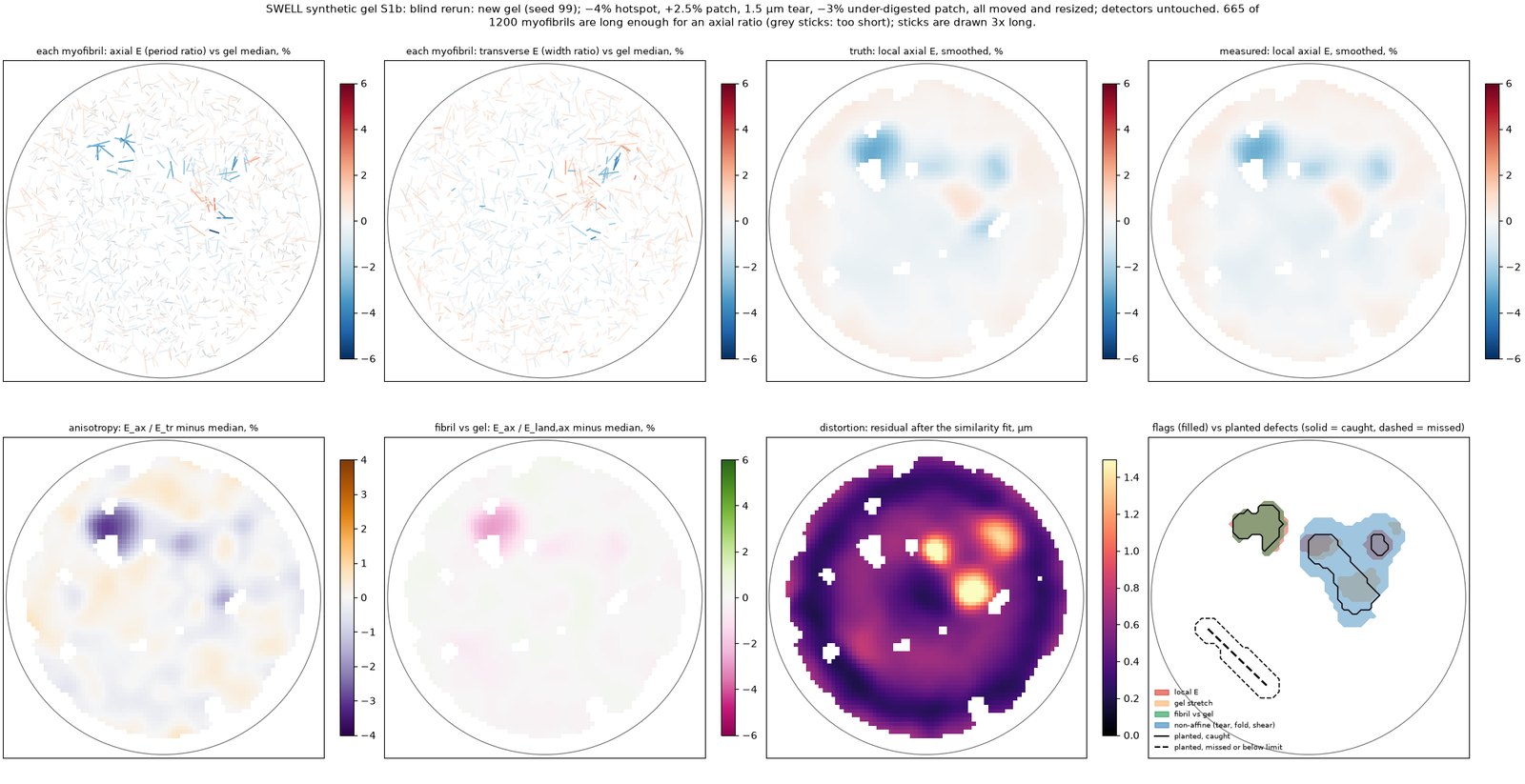
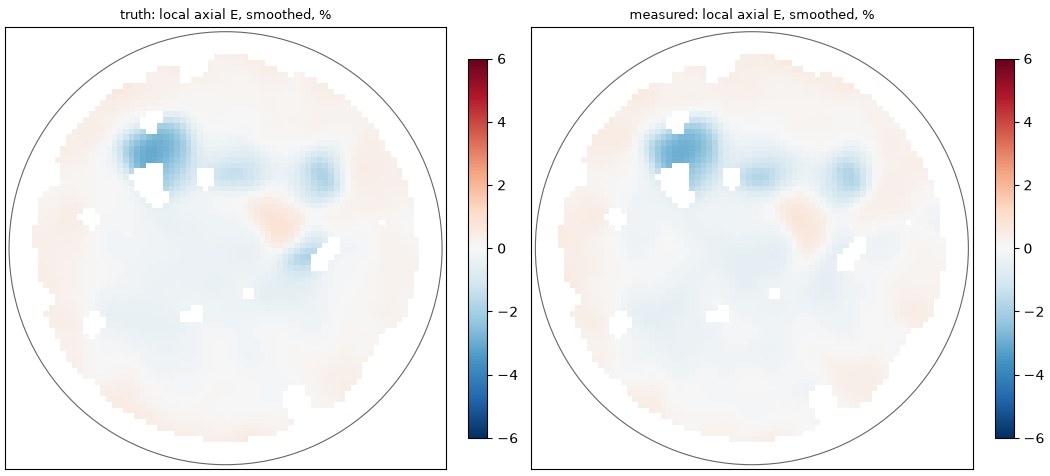
Our blind gel was made by the same generator with a new random seed, every planted defect moved and resized, and nothing tuned after it ran. It is not independent, because our generator shares our assumptions; a test gel built separately by a different AI agent, which may share our blind spots, is the harder test (see Tested harder). It holds 1,200 myofibrils in a 1.5 mm punch expanded 4.5×.
| Planted defect (blind gel) | Size | Flagged by its own detector | Flagged by any detector | Result |
|---|---|---|---|---|
| Under-expanded hotspot | −4% | 100% | 100% | PASS caught |
| Under-digested patch | −3% | 100% | 100% | PASS caught |
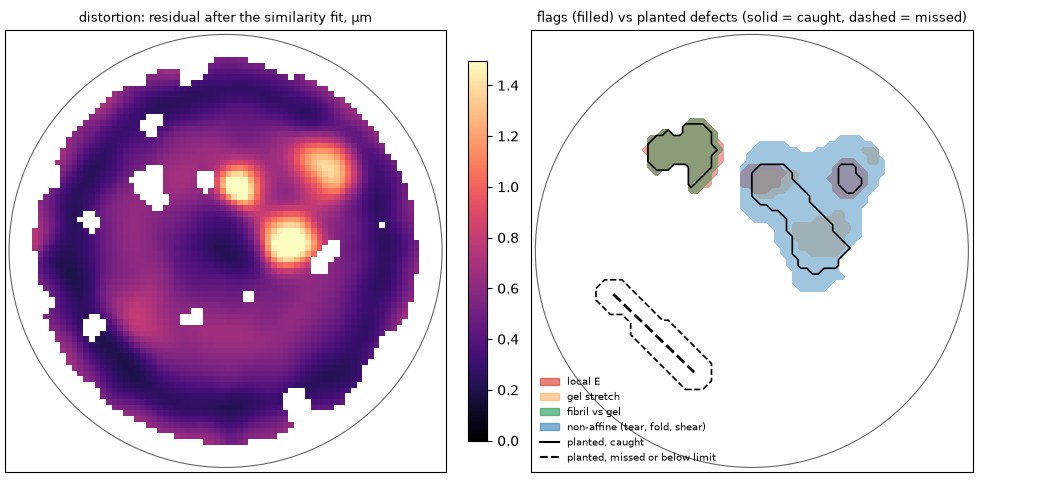
| Stretched patch | +2.5% | 51% | 100% | FAIL flagged everywhere, but by the non-affine detector: right place, wrong label |
| Tear | 1.5 µm | never crosses the detector threshold | BELOW LIMIT missed; the limit is ~2 µm | |
Pass rule: the detector named for the defect must flag at least 80% of its area.
The two misses, plainly: a mild +2.5% stretch is caught under the wrong label, and a 1.5 µm tear is too small to see. Across all four synthetic gels, 31 of 33 checks pass, 1 fails and 1 is below the detection limit. Three of the gels are development gels, because the detectors were fixed while looking at one of them; the fourth was our blind gel, and the test gel built separately by a different AI agent has since replaced it as the main test. On that development gel, a 2 µm tear was flagged over 89% of its area.
Coverage: on our own gels (version 1), about half the myofibrils carry the axial ruler
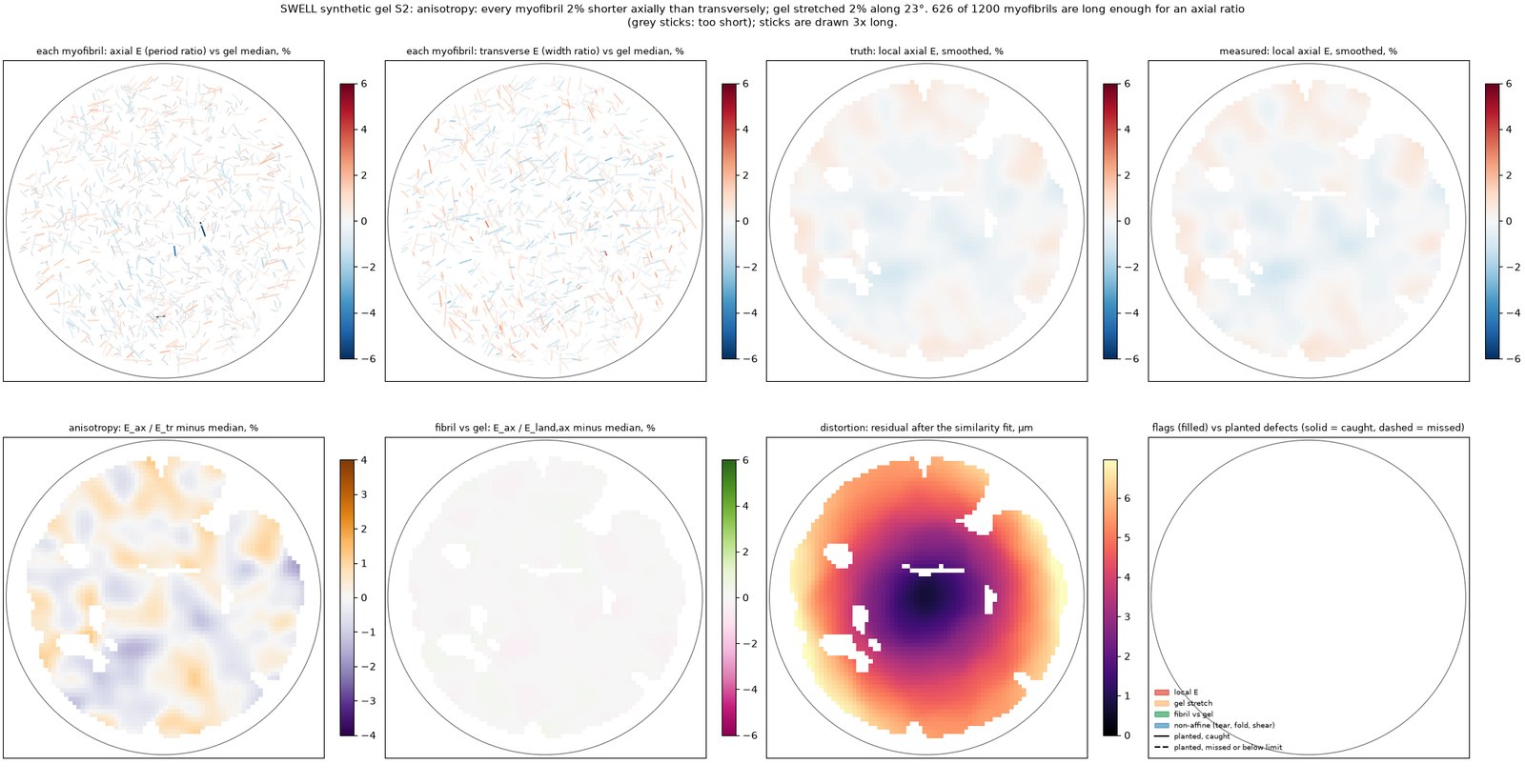
Every myofibril gets the transverse (width) ruler and the landmark (position) ruler. Only segments of at least 8 sarcomeres get the axial period ratio: 665 of 1,200 (55%) in the blind gel and 626 of 1,200 (52%) in the development gels. In real meat this would depend on how gently the tissue is homogenised.
Transverse isotropy and the shape-aware ruler
A gel can swell evenly along a myofibril and unevenly across it. So the pass criteria include transverse isotropy, Eax ÷ Etr − 1 within ±3% (95% CI, n ≥ 200 myofibrils), and the axial and transverse factors are always reported separately. That interval counts only the scatter between myofibrils, not error they all share, and on our synthetic gels it has proved too narrow (Tested harder, point 3), so a real test would have to use whole gels as the unit; that test isn't designed yet. On the blind gel the transverse factor per myofibril is 0.00% ± 0.50% (bias ± SD).
The width ruler is the fragile one: it needs a model of each cross-section. A boxy cross-section fitted as an ellipse is off by −9.0% to −15.2%, depending on the before-image method. So the pipeline measures each myofibril's cross-section shape from the expanded z-stack, and the bias drops to ≤ 0.04%.
Blur calibration still matters. If the before-image blur is calibrated 5% too wide, the bias is 1.05–3.23%, so the first gate calibrates it to ±2%. At that target the worst bias in our own model is 1.09%. The test gel built separately by a different AI agent showed the model is not enough: a blur shape the ruler does not model biased it by −17.8%, with the right blur widths or not.
On a development gel, a planted 2% anisotropy is recovered as −2.12% [−2.37%, −1.87%] (truth −2.03%), and a planted gel stretch of 2.00% along 23° is found by the orientation test as 2.03% along 23°.
A development gel: anisotropy and gel stretch
Optics, on paper
simulated
Sampling: 0.194 µm pixels against a Nyquist pixel of 0.200 µm, i.e. 1.03× Nyquist; the 10× track gets 0.84×.
Focusing into water: a dry objective imaging into a water gel suffers spherical aberration, but the Gibson–Lanni model gives the 4× objective a Strehl ratio, relative to the gel's surface, of at least 0.98 over 0–12 µm (index mismatch only: it leaves out the objective's own aberrations, its tube length and any coverslip error); worst over the specimen depth 0.99 (4×) and 1.00 (10×). Lateral PSF width 0.412 µm.
simulated
One gel at 4.5×: 804 tiles per plane × 10 planes, 25.5 GB of raw data, 1.3–2.2 h of scanning.
Model limits: magnification comes from a thin-lens model (a ray-traced model was planned but not done), and the camera's noise figures are assumptions not yet checked against a datasheet.
open problem
Not enough light in the worst case
Widefield optics see the whole thickness of an expanded myofibril, so out-of-focus light adds a background pedestal. At the lowest labelling simulated (0.5% of amines) on a 2 µm myofibril, the signal-to-noise ratio falls 12.4 → 5.6 against a target of 10. Reaching the target needs 3.2× the dose (exposure × irradiance), which costs bleaching. Before the pedestal was modelled, the first pass had given 12–42 across the labelling range.
Not solved. The named routes were a dose budget, deconvolution and a dye titration.
Tested harder
Weak spots found by a fresh check, and what changed
On 9 October 2026 the download was rerun from scratch by a check that had not built any of it: the fingerprint matched, all 11 tests passed and every number reproduced. Then the check listed what the tests could not show. Each point below is fixed, or stated as an open problem with its numbers. The first version was withdrawn on 10 October 2026, because it carried the original brief's superseded home-lab plan.
1 · A GEL BUILT SEPARATELY
A test gel we never saw
The old blind gel came from the same generator, and the pipeline was handed the before/after pairing. Now there is a test gel built separately by a different AI agent, which may share our blind spots. That agent read only the data format, never the detector code, and built in: lost fibrils, debris, a fold, a bubble, curved and bundled fibrils, tilted fibrils, expansion drifting during the scan, and its own blur and noise. The pipeline now matches the fibrils itself, and its result on that gel is published as the gel's builder scored it.
| The test gel built separately by a different AI agent, as its builder scored it (anisotropy truth converted to the pipeline's convention) | result |
|---|---|
| fibrils paired before ↔ after (recall · precision · wrong) | 96.3% · 100.0% · 0 |
| debris rejected | 100% |
| gel-mean axial error (median) | −0.14% (−0.01%) |
| per-myofibril axial error: RMS · typical spread · beyond ±2% | 1.8% · 0.31% · 7.5% |
| pairs that got an axial ratio | 28% |
| transverse ruler bias (a blur shape it does not model) | −17.8% |
| anisotropy Eax/Etr − 1: estimate vs truth | +24.7% vs +1.2% |
| flagged: bubble · fold · bundles · z-tilt · curved | 100% · 75% · 55% · 3% · 0% |
| flagged: under- and over-expanded patches | 0% · 0% |
| false flags on clean gel | 0.4% |
| drift left after the clock tile: straight-line slope ± standard error · median error in each of six time bins | −0.02%/h ± 0.10%/h · within ±0.1% |
simulated What failed: the transverse ruler read widths about a fifth too small on average, which made the anisotropy call wrong in size (the sign was right). The cause is not the blur calibration: rerun with the true blur widths, the bias is still −17.4%. It is a blur shape the ruler does not model, and the pipeline's own landmark ruler already disagreed with it by −19.7% while the call was still made. Fixed afterwards (a development fix, since this gel has now been seen): no anisotropy call while the two rulers disagree by more than 3%. On this gel the call is now blocked. The ordinary under- and over-expanded patches, the curved fibrils and the tilted region went unflagged, and only about a quarter of the pairs got an axial ratio. The pairing, the debris rejection and the gel-level factor held. Like our own gels, this gel reached the pipeline as one set of profiles per object, cut out of its builder's images by an emulated image front-end, so SWELL's own code never segmented or stitched an image in these tests: read the pairing and debris scores as best cases for real images. The drift correction held too, but the slope in the table can't show it: the planted drift rose to +0.48% and fell back, so even with no correction its straight-line slope would have been only +0.07%/h, smaller than that slope's standard error. What shows it is that after the clock tile, the median error in each of six time bins stays within ±0.1%. The slope also leaves out 10 of its 320 myofibrils, those with errors beyond 5%; with them it reads −0.15%/h. The local expansion flag already uses the landmark ruler's area change as well as the axial ratio, but it fires only where the change, smoothed by a Gaussian of 45 µm standard deviation, exceeds 1%, or four standard errors where that is larger, and nothing in the under-expanded patch crossed that line. How a patch's size and strength decide whether it is caught has not been measured. These are open problems; this gel has now been seen, so each fix needs a new blind gel.
2 · THE BEFORE-IMAGE IS LOAD-BEARING
A go/no-go for the stripes
simulated The axial ruler is only as good as the label-free stripes before expansion. Its error follows one number, q = striation contrast × √photons: go if q ≥ 1.2 (1% per myofibril at 10 sarcomeres). An uneven light that the old code ignored no longer seems to matter: with a 20% slope the per-myofibril error was 0.95% with the old code and is 0.28% now, against 0.34% and 0.39% with even light. Each figure is the RMS of its own 300 random draws, not shared between cases, with no confidence interval, so small differences mean little: the new code's lower figure with a slope than without one should not be read as a gain. predicted From the physics of each mode, the choice is differential phase contrast with four oblique LEDs (predicted contrast 2.3%, q ≈ 10, assuming about 200,000 detected photons per sample and shot noise only). In one acquisition, crossed polarisers lose fibrils near 0° and 90°: only 42%–78% of orientations reach the go line. A second acquisition with the polariser pair turned 45° was not simulated.
3 · A −0.1% BIAS
Broken ends, and effect sizes instead of "significant"
simulated The ladder used the Z-discs at the very ends of each fragment, which are cut in half, and that pulled the axial factor low. They are now ignored. The gel-mean error on our own five development gels is now −0.08% to 0.00%, and the per-myofibril error 0.15%–0.18% (under the simulated conditions listed in the numbers). "The confidence interval excludes zero" had called a perfect gel anisotropic; now anisotropy counts only beyond ±1%. On the perfect gel the estimate is −0.10% [−0.18%, −0.03%], called isotropic; a planted 2% anisotropy reads −2.16% [−2.44%, −1.81%] (truth −1.98%). The brackets are 95% confidence intervals from resampling myofibrils, which treats them as independent and leaves out error they all share, such as the blur and cross-section model, so they are too narrow: they miss the true value on 4 of our 5 own gels, and on the test gel built separately by a different AI agent. The ±1% rule also hides a small bias: on our own gels the transverse ruler reads +0.05% to +0.14% high. A corrected interval (the bias removed, a term for shared error, its coverage checked by simulation, whole gels as the unit) is an open problem.
4 · WHEN THE BEFORE-IMAGE IS TAKEN
After the gel sets, and the gap measured
untested A protocol decision, never run. The protocol took the before-image before anchoring and gelling, so any change in sarcomere length in between would read as an expansion error. The reference image is now taken after the gel sets, on the rinsed gel, and the first three gels are imaged before anchoring too, to measure what that step does. The rinse is not settled either: the plan rinses the gel in PBS, a salt solution, and a sodium-acrylate gel may start to swell or buckle in it (reasoning, not a measurement), so the first gels must also show that the rinse leaves the gel's size unchanged, or the rinse must move to a liquid that does.
5 · ENOUGH LIGHT
How much dye the signal needs
For a signal-to-noise ratio of 10 at today's exposure, 0.81%–1.58% of the protein's amines must carry a dye (0.41%–0.79% at 200 ms). A pan-ExM-strength stain is estimated to label about 1.4% (range 0.30%–9.6%); the original recipe's weaker stain, about 0.14% (range 0.030%–0.96%), probably falls short: only the top of its range reaches what is needed. The model treats every amine in the protein as free to take a dye, but the anchoring step is expected to use some amines first, which it leaves out, so the real share could be lower. So the first gels titrate stronger stains. untested Still open until real gels measure it.
6 · THE GEL KEEPS MOVING
A clock tile for scan-time drift
simulated A gel can keep swelling during a two-hour scan, which would paint a fake gradient in the order the tiles were taken. One tile is now re-imaged every 50 tiles as a clock. On a synthetic gel drifting by 0.5%, the error trend falls from 0.22%/h to −0.036%/h (straight-line slopes, without standard errors: none were computed for this gel).
Still failing: on the blind gel, the gently stretched patch is flagged mostly by the wrong detector (40% by its own, 92% by any), and a 1.5 µm tear stays below the detection limit. Both are listed as open problems.
Cited, simulated, predicted, untested
What is known, and how well
| Claim | Status | Evidence |
|---|---|---|
| Broiler breast sarcomeres average 1.69 µm (1.91 µm in wooden-breast fillets). | cited | A laser-diffraction study, read from its abstract |
| Mono IMX296 global-shutter boards for the Raspberry Pi exist (1456 × 1088 px, 3.45 µm); the official Pi Global Shutter Camera is colour, so it is not used. | cited | Vendor pages and the product brief |
| The NHS-ester pan-staining step follows the published pan-ExM method. | cited | The pan-ExM paper's full text, Methods |
| UK REACH Annex XVII bars supplying CMR substances to the public, and covers formaldehyde through Reg. (EU) 2018/675. | cited | The legislation itself |
| TREx reaches about 10× in one step; its published correction traces a lab discrepancy to the TEMED stock. | cited | The TREx paper and its correction |
| Bis-acrylamide is a Cat. 1B mutagen (Muta. 1B, H340) in Great Britain's legally binding classification list. | cited | Checked on 2026-10-10 against HSE's GB mandatory classification list (in legal effect from 2025-09-23); one supplier's 2023 sheet still leaves its solution unclassified (safety sources). Until 2026-10-10 this row said "untested". |
| The chicken A-band is about 1.6 µm long. | untested | Only a generic vertebrate value |
| The 40X objective's price. | untested | Seen only in a search result; the maker's page answers with an anti-bot check, so it is not yet read and stays out of the totals. The 20X objective's price was read on its shop page on 11 October 2026. |
| The camera's quantum efficiency, read noise and full well used in the light budget. | untested | Datasheet values not yet confirmed |
| The axial ruler measures each myofibril to 0.3–0.6% RMS on our own gels, but 1.8% on a test gel built separately by a different AI agent, which may share our blind spots (7.5% beyond ±2%). | simulated | strain_map_v1.json (own gels); strain_map_v2.json (the test gel built separately by a different AI agent) |
| Our own blind gel: whole-gel expansion error −0.11%, false flags 0.00%; the hotspot and the under-digested patch are caught. On the test gel built separately by a different AI agent the under- and over-expanded patches were not (0%, 0%). | simulated | strain_map_v1.json, our blind gel; strain_map_v2.json, the test gel built separately by a different AI agent |
| Known misses: the +2.5% stretch gets the wrong label; the 1.5 µm tear is below the limit. | simulated | strain_map_v1.json, our blind gel |
| With each cross-section's shape measured, the transverse ruler's bias is ≤ 0.04% in our width simulation and +0.05% to +0.14% across our own 5 synthetic gels with the current pipeline, but −17.8% on the test gel built separately by a different AI agent (a blur shape it does not model). | simulated | strain_map_v1.json (width simulation); strain_map_v2.json (own gels and the test gel built separately by a different AI agent) |
| The 4× track samples at 1.03× Nyquist, with a Strehl ratio, relative to the gel's surface and from index mismatch only, of at least 0.98 over 0–12 µm. | simulated | optics_v1.json (thin-lens and Gibson–Lanni models) |
| Signal-to-noise reaches 10 at the lowest labelling. | simulated: fails | optics_v1.json; an open risk |
| The full build costs ≥ £214: the sum of the lines priced so far, with shipping and labour left out. | cited | budget_v1.json; 3 of 31 lines priced from supplier pages, 28 not yet read, so no full total yet |
| Label-free before-images have enough contrast (5–50% assumed). | untested | calc_v0.json; an open risk |
| The gel chemistry expands chicken myofibrils evenly. | untested | Never run; an open risk |
| One button: chicken in, images, QC report and paper draft out. | untested | A design goal; the mechanical and fluidic designs and the instrument software were never written |
| No earlier expansion microscopy on a 3D-printed microscope was found, and no paired, label-free before-and-after period ratio on the same myofibril. Isolated vertebrate myofibrils have been expanded before (rabbit; a 2022 thesis). | untested | prior_art.md (10 searches, 10 Oct 2026), and 17 more searches the same day; nearest prior art: Zhang et al. 2016 (expansion on a mini-microscope) and expansion of muscle biopsies at neuromuscular junctions; a 2022 thesis on expanded myofibrillar bundles |
Nothing here is tagged "verified": on X-WOW that word is kept for a result re-derived from the raw material by a person who didn't build it. The JSON files are the simulation outputs, published unchanged with this site.
Nothing has been built: every SWELL result above came from a simulation or a price page; no gel has been made and no part has been bought.
Evidence ladder
Cheapest tests first
Before anyone spends money on a lab, three home rungs, each done with an adult, test the parts of SWELL that chemistry can't fix: can the stripes be measured, are they bright enough to be a ruler, and are the fragments long enough? Each rung has a pass mark and a safety note.
RUNG 1
Measure a chicken with a laser
Shine a laser pointer through a thin strip of chicken breast and measure the diffraction spots: the sarcomere length falls out of one line of maths. How to do it.
- Pass
- first-order spots on both sides; three strips within ±5% of their mean, inside 1.5–2.0 µm
- Safety
- a family experiment, age guide 8 and up: the adult handles the laser, the knife, the glass and the raw chicken. Use a red (650 nm) Class 2 pointer, 1 mW or less: cheap green ones can leak invisible infrared. Never at eyes or shiny surfaces; lay the strip so the fibres run level, which keeps the side spots at table height; hold the slides in a peg or clip, not fingers; raw-meat hygiene
RUNG 2
See the stripes
Blend a pea-sized piece of chicken breast for a few seconds in ice-cold, weak salt water (6 g of salt per litre; much stronger brine dissolves the stripes), put a drop under a coverslip on any microscope with a 40× objective, and let swell-ruler measure the stripes. Plain bright-field with the condenser wide open shows almost nothing: close the condenser iris or tilt the lamp's light (never sunlight). Measure your pixel size with a stage micrometer (or from your rung-1 sarcomere length). No stain and no lab chemicals.
- Pass
- median q of 1.2 or more (rescaled to 0.194 µm pixels; use raw frames, ideally from a mono camera: a colour camera's demosaicing and any denoising or JPEG compression smooth the noise and make q read too high; sharpening changes it too; saving such a frame as PNG doesn't undo that) over 10+ myofibrils with 10+ sarcomeres: SWELL's go/no-go for the label-free ruler. Bright-field in salt water is not the design's DPC in a gel, so a pass is encouraging, not proof; and q is read from the image's own noise, so a check that doesn't depend on it, measuring each fibril's period twice (two frames, or its two halves), is still to be built
- Safety
- age guide 10 and up, with an adult. Use the microscope's own lamp: never light it with sunlight or point its mirror at the sun. Kitchen salt only. The adult handles the raw chicken, runs the blender, and handles the coverslip, the glass slides and the stage micrometer; children look and run the software. Raw-meat hygiene
RUNG 3
Long enough fragments
The ruler needs fragments with at least 8 sarcomeres. The same images give a length histogram; gentler blending keeps fragments longer.
- Pass
- 40% or more of fragments with 8+ sarcomeres (the simulation assumed 44%)
- Safety
- as rung 2
RUNG 4 · LAB ONLY
First gels in a proper lab
Only once rungs 1–3 pass, and only in a lab with a fume hood, under its own safety rules. The gel chemistry uses restricted carcinogenic reagents. Never at home.
- Pass
- 3 gels: pre-image q ≥ 1.2; per-myofibril axial precision ≤ 1% (
per_fibril_spreadin result.json); isotropy inside the ±3% gate (how to judge it is open: one gel's interval over its myofibrils has proved too narrow on our synthetic gels, so the gels themselves should be the unit). Reported, not a pass mark: the gel-mean axial factor next to the overview camera's whole-gel factor (the gel's diameter after ÷ before), and their ratio. A gate of ±0.5% on that ratio was dropped on 10 October 2026, before anyone climbed: a whole gel's factor is itself uncertain (observers' estimates of one gel ranged from 8.6 to 9.4 in GelMap, Damstra et al. 2023), and a myofibril may expand less than its gel. - Safety
- the safety section, the lab's own risk assessment, and nothing chemical outside it
Parts and cost
What it costs, as far as prices have been read
Prices are in pounds including VAT. Listed means read on a supplier page, on the date the full list gives. Estimate means an earlier figure from the design notes, not a price read from a supplier.
target ≤ £500 · 2 of 24 lines read from a supplier (together ≥ £103), the rest estimated
target ≤ £650, ceiling £1,000 · 3 of 31 lines read from a supplier (together ≥ £214), the rest estimated
These totals are estimates, not quotes; only a few lines have a price read from a supplier. On these estimates both are above target: the core at ≈ £568–£1,017 against ≤ £500, the full build at ≈ £805–£1,353 against ≤ £650. Prices change over time.
| Line | Part | Scope | GBP | Basis | Part no. |
|---|---|---|---|---|---|
| H-15 | Filter set, GFP class (excitation, dichroic, emission) | core | est. £100–£250 | estimate | — |
| H-10 | Objective A: Motic PL 40X/0.65 plan achromat | core | est. £112 | estimate | PL 40X/0.65/S |
| H-21 | Objective B: Motic PL 20X/0.40 plan achromat | build | £111 | listed | PL 20X/0.40 |
| H-05 | Raspberry Pi 5, 4 GB | core | £54–£60 | listed | — |
| H-09 | Main camera: IMX296 mono global shutter (Waveshare) | core | £49.87 | listed | IMX296-130-BW |
| H-11 | Tube lens: achromatic doublet, f = 100 mm | core | est. £45–£70 | estimate | AC127-100-A |
| H-23 | Peristaltic pumps (reagent lines and waste) | build | est. £40–£75 | estimate | — |
| H-28 | 12 V rail for the pumps: MEAN WELL DDR-60G-12 enclosed DC-DC converter | build | est. £35–£50 | estimate | DDR-60G-12 |
| H-19 | Certified low-voltage PSU, buck converter, fuses, relay latch, wiring | core | est. £50–£90 | estimate | — |
| H-30 | Closed electronics compartment (the 12 V and 5 V converters out of reach) | core | est. £15–£35 | estimate | — |
| H-12 | Overview camera: Raspberry Pi Camera Module 3 + close-up lens | core | est. £25–£32 | estimate | SC0872 |
| H-13 | Excitation LED (blue) + constant-current driver | core | est. £12–£20 | estimate | — |
| H-14 | Transmitted white LED + four oblique LEDs for the label-free pre-image (DPC) + drivers | core | est. £8–£15 | estimate | — |
| H-18 | Black box + lid microswitch (interlock: LED and motors) | core | est. £10–£15 | estimate | — |
| H-03 | 28BYJ-48 steppers with ULN2003 boards | core | est. £10–£14 | estimate | — |
| H-01 | OpenFlexure v7 printed parts (PLA) | core | est. £8–£12 | estimate | — |
| H-29 | Print service for the printed parts (no printer of your own) | core | est. £0–£135 | estimate | — |
| H-20 | Drip ring + objective sleeve + leak sensor | core | est. £6–£10 | estimate | — |
| H-04 | Raspberry Pi Pico 2 (motor, LED and safety controller) | core | est. £5–£7 | estimate | — |
The main parts only. In the price column, "est." marks an estimate (an earlier figure, not a supplier price); in the part-number column, that the list gives no part number for that line. The full list, all 45 lines with each one's price basis, supplier, part number and safety rating, is swell-bom-2026-10-12.csv (a CSV file: pm/BOM.csv from the download, after three lines saying what it is, who wrote it and its licence). H-01's optics module is not a stock OpenFlexure part: OpenFlexure's v7 high-resolution module takes a 50 mm tube lens (Thorlabs AC127-050-A, per its build pages, read 10 October 2026), and they list no version for SWELL's 100 mm lens, so a modified module would have to be drawn; none has been. Every price read so far is in pounds, so no total uses a currency conversion.
Safety ratings of the parts
Where the bill of materials names a maker's part, its rating is read from that maker's own documents: a datasheet, certificate, manual or wiki (read 2026-10-10; H-13's and H-28's on 2026-10-11). Where it names none, or the part carries no rating, the line says what the part must carry: a requirement reasoned from SWELL's safety rules, not a test. Shops named elsewhere on this page are price sources only. The requirements marked "no document" have no maker's document behind them.
| Line | Part | Safety rating | Source |
|---|---|---|---|
| H-02 | OpenFlexure fixings: screws, nuts, washers, bands, inserts | Small loose parts (screws, nuts, washers, inserts, bands): a choking hazard, so adult assembly, away from under-threes. requirement; no maker rating | Reasoned from SWELL's safety rules; no document. |
| H-03 | 28BYJ-48 steppers with ULN2003 boards | Run from the instrument's fused 5 V rail; the gears they drive sit under fixed printed covers (H-27), and opening the lid cuts their supply. requirement; no maker rating | Reasoned from SWELL's safety rules; no document. |
| H-04 | Raspberry Pi Pico 2 | Raspberry Pi: 1.8–5.5 V DC input; any external supply must be a limited power source or PS2 under IEC 62368-1. maker's document | Raspberry Pi Ltd, Raspberry Pi Pico 2 series product brief, Published March 2026 (file RP-008302-DS-2). pip-assets.raspberrypi.com |
| H-05 | Raspberry Pi 5, 4 GB | Raspberry Pi: 5 V/5 A DC via USB-C; CB test certificate DK-147036-UL: a tested sample conforms to IEC 62368-1:2018. maker's document | Raspberry Pi Ltd, Raspberry Pi 5 product brief, Published October 2026 (file RP-008348-DS-8). pip-assets.raspberrypi.com · Raspberry Pi Ltd (Product Information Portal); certificate issued by a UL National Certification Body, rpi-5 Electrical Safety Certification Body (CB) Certificate, dated 2023-11-07. pip-assets.raspberrypi.com |
| H-06 | Raspberry Pi 27 W USB-C power supply | Plug-in mains adapter, 100–240 V AC in; USB-C PD out 5.1 V 5 A, up to 15 V 1.8 A; CB-certified to IEC 62368-1:2018. maker's document | Raspberry Pi Ltd (Product Information Portal); certificate issued by UL Solutions, rpi-27W-PSU IEC CB Scheme Grant (CB test certificate), CB test certificate DK-145484-UL, dated 2023-09-20. pip-assets.raspberrypi.com · Raspberry Pi Ltd, Raspberry Pi 27W USB-C Power Supply product brief, Published October 2023. datasheets.raspberrypi.com |
| H-08 | Raspberry Pi 5 active cooler | Raspberry Pi: 5 V DC from the Pi 5's fan header; its metal parts can get hot, and the fan isn't to be touched while powered. maker's document | Raspberry Pi Ltd, Raspberry Pi Active Cooler for Raspberry Pi 5 product brief, Published January 2026 (file RP-008188-DS-2). pip-assets.raspberrypi.com |
| H-11 | Tube lens: achromatic doublet | Loose glass lens that can focus sunlight: keep it mounted in the tube and never aim it at the sun. requirement; no maker rating | Reasoned from SWELL's safety rules; no document. |
| H-12 | Overview camera: Camera Module 3 + close-up lens | Camera Module 3 has no safety rating; connect it only with the Pi shut down and unplugged. Close-up lens not chosen: never aim it at the sun. requirement; no maker rating | Raspberry Pi Ltd, Raspberry Pi Camera Module 3 product brief, Published June 2024 (file RP-008151-DS-1). pip-assets.raspberrypi.com |
| H-13 | Excitation LED (blue) + constant-current driver | Driver (Mean Well LDD-350HW, the version with 22 AWG leads fitted): 9–56 V DC in, 350 mA constant current, short-circuit and over-temperature protected. LED not chosen. Requirement: the light as fitted, LED plus diffuser, in IEC 62471's Exempt or Risk Group 1 ("low risk") group, by its maker's rating or a measurement; a bare high-power blue LED can be Risk Group 2 (an ams-OSRAM application note gives a 470 nm, 5 cd blue LED as Risk Group 2). It sits inside the light-tight box, and the lid microswitch (H-18) cuts its supply when the lid opens. maker's document | MEAN WELL, LDD-H series DC-DC Constant Current Step-Down LED driver specification, File Name: LDD-H-SPEC 2022-05-24. meanwell.com · International Electrotechnical Commission (IEC webstore), IEC 62471:2006 Photobiological safety of lamps and lamp systems (catalogue entry), IEC 62471:2006, edition 1.0, publication date 2006-07-26. webstore.iec.ch · ams-OSRAM, Details on photobiological safety of LED light sources, Application Note AN002, 2025-09-16 (read 2026-10-12). ams-osram.com |
| H-14 | White and oblique LEDs + drivers | Not chosen: each LED's maker must rate it in IEC 62471's Exempt group, because the lid interlock covers only the excitation LED; constant-current drivers on the fused 24 V-or-less supply. requirement; no maker rating | International Electrotechnical Commission (IEC webstore), IEC 62471:2006 Photobiological safety of lamps and lamp systems (catalogue entry), IEC 62471:2006, edition 1.0, publication date 2006-07-26. webstore.iec.ch |
| H-15 | Filter set (excitation, dichroic, emission) | Not chosen: glass filters and dichroic are fitted by an adult and held in their mounts inside the closed box. requirement; no maker rating | Reasoned from SWELL's safety rules; no document. |
| H-17 | C12 chamber + kinematic dish holder (magnets, balls) | Not chosen: magnets within EN 71's flux limit, held captive or enclosed so they can't come loose; balls are small parts; adult assembly; coverslip adult-only. requirement; no maker rating | Office for Product Safety and Standards (GOV.UK), Product Safety Alert: Small, High-Powered Magnetic Products (PSA1), Published 5 April 2022; date of issue 19 May 2021. gov.uk |
| H-18 | Black box + lid microswitch (interlock: LED and motors) | Not chosen: a two-pole switch, its contacts rated above the LED supply and the relay coil it drives; one pole cuts the LED, the other opens a relay that stops every motor, and an open lid or a broken wire does both. requirement; no maker rating | Reasoned from SWELL's safety rules; no document. |
| H-19 | Low-voltage supply, buck converter, fuses, relay latch, wiring | Not chosen: a certified plug-in adapter (IEC 62368-1), 24 V DC or less out; a fuse on every rail; every part rated for its rail's voltage and current; the 5 V converter an enclosed DIN-rail module like H-28, and it, the fuses and the relay board sit in the closed electronics compartment (H-30); every join the builder makes a screw or lever terminal (H-31) or a ready-made plug-in lead; the 24 V fuse a time-delay type that rides through the converters' inrush. The 12 V pumps (H-23) get their rail from H-28. requirement; no maker rating | Raspberry Pi Ltd, Raspberry Pi Pico 2 series product brief, Published March 2026 (file RP-008302-DS-2). pip-assets.raspberrypi.com |
| H-20 | Drip ring + objective sleeve + leak sensor | Leak sensor not chosen: runs on the low-voltage logic rail, and its trip opens the hardware latch directly requirement; no maker rating | Reasoned from SWELL's safety rules; no document. |
| H-22 | Cartridge: body, glass floor, seals, mesh guard, weir | Not chosen: body and seals rated compatible with every liquid it holds, so it can't leak over the optics; glass floor is adult-only. requirement; no maker rating | Reasoned from SWELL's safety rules; no document. |
| H-23 | Peristaltic pumps | Not chosen: 12 V DC motors on the fused 12 V rail (H-28), each roller head enclosed by its maker's cover, stopped by the lid interlock and by the hardware leak latch. requirement; no maker rating | Reasoned from SWELL's safety rules; no document. |
| H-24 | Tubing and connectors | Not chosen: tubing and fittings rated by their maker as compatible with every liquid they carry, so they don't soften, crack or leak. requirement; no maker rating | Reasoned from SWELL's safety rules; no document. |
| H-25 | Leak sensors + waste overfill sensor | Not chosen: low-voltage sensors on the logic rail; each trip opens the hardware latch that cuts pumps, heaters and the LED. requirement; no maker rating | Reasoned from SWELL's safety rules; no document. |
| H-26 | Pump and LED driver board (MOSFET) | Not chosen: each switch rated well above 24 V and its load current, flyback diodes on the pumps; the LED stays behind the interlock and latch. requirement; no maker rating | Reasoned from SWELL's safety rules; no document. |
| H-27 | Printed gear guards (PLA) | Not drawn yet: printed PLA covers fixed over the steppers' gears, removable only with a tool, so fingers and hair can't reach the gears; fitted by an adult. requirement; no maker rating | Reasoned from SWELL's safety rules; no document. |
| H-28 | 12 V rail for the pumps: MEAN WELL DDR-60G-12 enclosed DC-DC converter | MEAN WELL DDR-60G-12: 9–36 V DC in, 12 V DC out at up to 5 A (60 W); short-circuit, overload, over-voltage, input reverse-polarity and under-voltage protection; approved to IEC 62368-1 and UL 62368-1; an enclosed converter with screw terminals, cooled by free air (full load up to 60 °C ambient above 18 V input). It sits on a DIN rail inside the closed electronics compartment (H-30), out of reach, and its output to the pumps passes through the lid relay and the leak latch. maker's document | MEAN WELL, DDR-60 series 60W DIN Rail Type DC-DC Converter specification (2026-03-31). meanwell.com |
| H-29 | Print service for the printed parts | The builder doesn't run a printer: a print service prints the parts, and they arrive cold, to be fitted by an adult. requirement; no maker rating | Reasoned from SWELL's safety rules; no document. |
| H-30 | Closed electronics compartment | Not chosen: a closed compartment that opens only with a screwdriver and is opened only with the supply unplugged (a rule, not an interlock), with no opening wider than 2.5 mm and vents for free-air cooling; metal, or plastic rated UL94 V-0. It keeps H-28 and the 5 V converter out of reach. requirement; no maker rating | Reasoned from SWELL's safety rules; no document. |
| H-31 | Solderless joins: lever connectors and screw terminals | Not chosen: lever connectors and screw terminal blocks, each rated above its rail's voltage and current and for its wire's size: no soldering and no crimping anywhere in the build. requirement; no maker rating | Reasoned from SWELL's safety rules; no document. |
| C-01 | Stage micrometer | Not chosen: a glass slide, so adult handling only; no electrical, optical or chemical hazard. requirement; no maker rating | Reasoned from SWELL's safety rules; no document. |
| C-02 | USAF 1951 resolution target (glass) | Not chosen: a glass target, so adult handling only; no electrical, optical or chemical hazard. requirement; no maker rating | Reasoned from SWELL's safety rules; no document. |
| C-03 | Fluorescent beads, 100–200 nm | Thermo Fisher SDS: not classified as hazardous, no H-statements. Its user guide: most FluoSpheres carry 2 mM azide or 0.02% thimerosal as preservative. maker's document | Life Technologies Corporation (Thermo Fisher Scientific), Safety Data Sheet, F8803 FluoSpheres carboxylate-modified microspheres, 0.1 µm, yellow-green (North American SDS), Revision number 3, revision date 16-Aug-2024. assets.thermofisher.com · Thermo Fisher Scientific, FluoSpheres user guide, Pub. No. MAN0001849, Rev. B.0. assets.thermofisher.com |
| C-04 | Uniform fluorescent reference (flat-field) | Not chosen: prefer a solid fluorescent slide; any liquid or dye reference needs its maker's SDS cited and stays in the lab. requirement; no maker rating | Reasoned from SWELL's safety rules; no document. |
| T-03 | Multimeter: UNI-T UT61E+ | UNI-T: built to IEC 61010-1, CAT III 1000 V / CAT IV 600 V. In SWELL it measures only the 24 V-or-less DC circuits. maker's document | UNI-T (Uni-Trend), UT61+ Series 1000V True RMS Digital Multimeter user manual (UT61B+/UT61D+/UT61E+), P/N:110401109614X (no date printed). meters.uni-trend.com |
| T-04 | Hand tools | Cutters and wire strippers have blades and fine tweezers are pointed: adult use only. requirement; no maker rating | Reasoned from SWELL's safety rules; no document. |
| W-01 | Reagents, first fill | Lab only: the supplier SDS of each hazardous reagent is cited on the Safety and lab page's table and in SAFETY.md (read 2026-10-10); none yet for the dye (not chosen), poly-L-lysine or PBS; several are CMR. requirement; no maker rating | Reasoned from SWELL's safety rules; no document. |
| W-02 | Coverslips, glass-bottom dishes, punches, gloves | Lab only: coverslips, glass-bottom dishes and punches are sharp (adults); gloves are the chemical-resistant kind each reagent's SDS names. requirement; no maker rating | Reasoned from SWELL's safety rules; no document. |
| W-03 | Host-lab equipment: pipettes, centrifuge, 95 °C block, incubator | The host lab's own equipment, used as its makers intend: the 95 °C block can scald and burn; centrifuges stay lidded while spinning. requirement; no maker rating | Reasoned from SWELL's safety rules; no document. |
Everything else a first build would need
| Basket | GBP (listed lines only) | Not yet read / all lines |
|---|---|---|
| Calibration: stage micrometer, resolution target, fluorescent beads, flat-field reference | — | 4 / 4 |
| Tools, only if the lab has none: multimeter, hand tools (no hot tools) | ≥ £69 | 1 / 2 |
| Operations: data drive, host-lab access for six months (community-lab case; its price source isn't public, so it can't be checked), waste route | ≥ £240 | 2 / 3 |
| Wet lab, bought through a host lab: reagents and consumables | — | 3 / 3 |
| Whole project, excluding tools (includes the host-lab line above, whose source isn't public) | ≥ £454 | 37 / 41 |
Where the chemistry happens
Finding a suitable lab, anywhere
The gel chemistry belongs only in an equipped, supervised laboratory that works under its own safety rules. We name no labs here: this is the list of what to ask one for. Nobody has been contacted about SWELL.
- A fume hood, or local exhaust ventilation, for weighing powders and for the formaldehyde and monomer steps.
- Written permission for these reagents: acrylamide, bis-acrylamide and formaldehyde (CMR substances), APS, TEMED, sodium acrylate, imidazole, an SDS buffer at 95 °C and NHS-ester dyes in DMSO.
- A hazardous-waste route for liquids and polymerised gels, and what it costs.
- An ordering route: the lab orders the CMR reagents, because suppliers may not sell them to private individuals. Never present yourself as a business if you are not one.
- Lockable chemical storage, and fridge and freezer space for reagents and gels.
- Basic equipment: pipettes, a mini-centrifuge, a heat block reaching 95 °C, an incubator, a balance and a pH meter.
- Bench space for a small low-voltage microscope for a few months, under the lab's own induction, risk assessments and lone-working rules.
- Then choose: among the labs that confirm the first four points, the cheapest that can start when you need it.
Safety
The chemistry is the dangerous part
Wet work only in a proper lab with a fume hood. Nothing chemical at home.
Several reagents are carcinogens, mutagens or reproductive toxicants (CMR substances). Not in a kitchen, a garage or a spare room. Follow the host lab's induction and risk assessments. Each chemical's hazard below is read from a named supplier's safety data sheet (SDS), cited in its row and listed under the table; raw chicken has no sheet. Suppliers' sheets differ and change, so check the one for the product you use. This is a starting list, not a risk assessment.
| Reagent | Hazard, from the SDS cited where there is one | Handling: the project's notes, checked against the sheets |
|---|---|---|
| Acrylamide (40% solution) | Danger. May cause cancer and genetic defects (Cat. 1B); suspected of damaging fertility; damages organs, including the nervous system, through prolonged or repeated exposure; may cause an allergic skin reaction; harmful if swallowed; irritates skin and eyes. H302, H315, H317, H319, H340, H350, H361f, H372: the label of this 40% solution. It can be absorbed through the skin: the UK exposure limit in the sheet's section 8 carries the skin notation of HSE's EH40/2005. As a substance, HSE's GB list classes acrylamide toxic if swallowed (Acute Tox. 3, H301). SDS: Fisher Scientific UK BP1402-1, rev. 2024-02-09 | Use it as a 40% solution, never as powder, and only in a fume hood (its sheet: "Use only under a chemical fume hood"), with double nitrile gloves, goggles and lab coat. |
| Bis-acrylamide (solution) | May cause genetic defects: HSE's GB mandatory classification list, legally binding in Great Britain, has it as Muta. 1B (H340; GHS08, Danger), in legal effect since 2025-09-23, with suppliers to comply by 2027-03-23. Fisher's SDS lists the bis in its solution (under 5% in water) as toxic if swallowed (H301), harmful in contact with skin (H312), may cause genetic defects (H340), may cause cancer (H350), suspected of damaging fertility or the unborn child (H361) and causes damage to organs through prolonged or repeated exposure (H372), yet leaves the solution itself unclassified; that sheet is older than the GB entry. SDS: Fisher Scientific UK BP1404-250, rev. 2023-10-13 | Treat as CMR. Use it as a solution. |
| Formaldehyde (16%, methanol-free) | Danger. May cause cancer (Cat. 1B); suspected of causing genetic defects; harmful if swallowed, in contact with skin or if inhaled; may cause an allergic skin reaction; irritates skin, eyes and airways. H302 + H312 + H332, H315, H317, H319, H335, H341, H350: the label of this 16% solution. As a substance, HSE's GB list classes formaldehyde fatal if inhaled (Acute Tox. 2, H330) and corrosive to skin (Skin Corr. 1B, H314), in an entry revised with legal effect from 2025-02-15; this sheet's section 3 still gives the older component classes. SDS: Avocado Research Chemicals (Thermo Fisher Scientific) 43368, rev. 2026-04-13 | Methanol-free sealed ampoules, opened only in a fume hood; small volumes. The overnight anchoring step runs in a sealed box. |
| APS (ammonium persulfate) | Danger. Oxidiser: may intensify fire; may cause allergy or asthma symptoms or breathing difficulties if inhaled; may cause an allergic skin reaction; harmful if swallowed; irritates skin, eyes and airways. H272, H302, H315, H317, H319, H334, H335 SDS: Fisher Scientific UK BP179-25, rev. 2024-09-09 | Weigh into closed, pre-tared vials with minimal dust; keep away from combustible materials. Stock made as 10% w/v in batches of at least 1 g, aliquoted and frozen. |
| TEMED | Danger. Highly flammable liquid and vapour; causes severe skin burns and eye damage; harmful if swallowed or inhaled. H225, H302 + H332, H314 SDS: Fisher Scientific UK BP150-20, rev. 2023-10-13 | Only in a fume hood (its sheet: "Use only under a chemical fume hood"); small quantities, kept closed, stored in a flammables cabinet away from heat and ignition sources. |
| Sodium acrylate | Warning. Very toxic to aquatic life (H400) and toxic to aquatic life with long-lasting effects (H411). This supplier's SDS gives no health hazard class, though its first-aid section says contact may cause mild irritation. Purity matters. SDS: Glentham Life Sciences GX3080, rev. 2026-05-12 (EU format) | Weighed as a powder in closed vials. Choose high purity and reject yellow solutions. Collect as waste; never down the drain. |
| Acrylic acid and sodium hydroxide (only to make sodium acrylate in the lab, a fallback) | Danger. Acrylic acid: flammable; causes severe skin burns and eye damage; harmful if swallowed, in contact with skin or if inhaled; irritates airways; very toxic to aquatic life (H226, H302 + H312 + H332, H314, H335, H400). Sodium hydroxide: causes severe skin burns and eye damage; may be corrosive to metals (H290, H314). SDS: Fisher Scientific UK 164250010, rev. 2023-09-22; Fisher Scientific UK BP359-500, rev. 2023-10-13 | Fume hood only. Neutralising one with the other gives off heat. A fallback in the project's notes, not the plan. |
| SDS (sodium dodecyl sulfate) buffer at 95 °C | Danger. Causes serious eye damage; harmful if swallowed; irritates skin; harmful to aquatic life with long-lasting effects. H302, H315, H318, H412. At 95 °C, also a scald hazard. SDS (the solid): Fisher Scientific UK BP166-500, rev. 2023-10-13 | Goggles. Screw-cap or lid-lock tubes in a lidded heat block, never on the microscope stage. |
| DMSO (dye solvent) | Not classified as hazardous under GB CLP; a combustible liquid. Its SDS warns that it readily penetrates skin and may carry other dissolved chemicals into the body. SDS: Fisher Scientific UK BP231-100, rev. 2023-10-13 | Always gloves; away from heat. |
| Triton X-100 | Danger. Causes serious eye damage; harmful if swallowed; toxic to aquatic life with long-lasting effects. H302, H318, H411 SDS: Fisher Scientific UK BP151-100, rev. 2024-04-04 | Goggles. Collected as waste, never down the drain. |
| Imidazole (rigor buffer) | Danger. May damage the unborn child (Repr. 1B, as in HSE's GB mandatory classification list); causes severe skin burns and eye damage; harmful if swallowed; the solid may form combustible dust in air. H302, H314, H360D SDS: Fisher Scientific UK BP305-50, rev. 2023-10-13 | Treat as CMR. Weigh and handle the solid only in a fume hood (its sheet: "Use only under a chemical fume hood"), with gloves and goggles. The lab's risk assessment must cover a reproductive toxicant. |
| Sodium azide | Not added in any gel step. The calibration beads (BOM line C-03) may bring it in: Thermo Fisher's FluoSpheres user guide says they are sold "in most cases containing 2mM azide or 0.02% thimerosal as a preservative"; their North American SDS (F8803, rev. 2024-08-16) lists no hazard. | Gels are stored in water in the lab's fridge instead. Bead suspensions leave by the lab's waste route: their SDS says to "avoid discharge into drains and waterways whenever possible". |
| Raw chicken | Campylobacter and Salmonella risk until fixed. | Food-hygiene practice; dedicated tools. |
Also in the design, with no hazard class in the SDS read: EGTA (Avocado Research Chemicals A16086, rev. 2024-02-11), Tris base (Fisher Scientific UK BP152-1, rev. 2023-10-13), sodium bicarbonate (BP328-500, rev. 2023-10-13) and sodium chloride (BP358-1, rev. 2026-02-06), all GB format. No dye is chosen yet (an NHS-ester dye of the Alexa Fluor 488 or ATTO 488 class, dissolved in DMSO), and no SDS was opened for poly-L-lysine or PBS: use the sheet for the product you use.
The safety data sheets behind this table
All read on 2026-10-10, each the supplier's own sheet as its site served it that day. Revision dates are the sheets' own. Suppliers revise their sheets, so check the current one for the product you use. Naming a supplier is not an endorsement and nothing here is a place to buy: these are the sheets we could open, from suppliers the project's notes name (Merck, Fisher, Thermo; Merck's would not open for us), plus one UK supplier for sodium acrylate. "GB format" means the sheet is written to UK SI 2019/758 and classifies under GB CLP. This table was written from these sheets.
- Acrylamide Solution, 40%, BP1402-1: SDS by Fisher Scientific UK, GB format, revision 9, 2024-02-09. fishersci.co.uk (PDF)
- Bis-Acrylamide Solution, BP1404-250: SDS by Fisher Scientific UK, GB format, revision 5, 2023-10-13. fishersci.co.uk (PDF)
- Paraformaldehyde, 16% w/v aqueous solution (formaldehyde 16% in water, no methanol in its listed composition), 43368: SDS by Avocado Research Chemicals (part of Thermo Fisher Scientific), GB format, revision 9, 2026-04-13. fishersci.co.uk (PDF)
- Ammonium Persulfate, BP179-25: SDS by Fisher Scientific UK, GB format, revision 10, 2024-09-09. fishersci.co.uk (PDF)
- N,N,N′,N′-Tetramethylethylenediamine (TEMED), BP150-20: SDS by Fisher Scientific UK, GB format, revision 8, 2023-10-13. fishersci.co.uk (PDF)
- Sodium acrylate, Glentham Life Sciences GX3080: SDS version 3.1 by Glentham Life Sciences (UK), written to EU REACH (EC) 1907/2006 and (EU) 2020/878, revision 2026-05-12. glentham.com (PDF)
- Acrylic acid, stabilized, 164250010: SDS by Fisher Scientific UK, GB format, revision 11, 2023-09-22. fishersci.co.uk (PDF) · Sodium hydroxide, BP359-500: SDS by Fisher Scientific UK, GB format, revision 13, 2023-10-13. fishersci.co.uk (PDF)
- Sodium dodecyl sulfate, BP166-500: SDS by Fisher Scientific UK, GB format, revision 9, 2023-10-13. fishersci.co.uk (PDF)
- Dimethyl sulfoxide, BP231-100: SDS by Fisher Scientific UK, GB format, revision 13, 2023-10-13. fishersci.co.uk (PDF)
- Triton X-100, BP151-100: SDS by Fisher Scientific UK, GB format, revision 15, 2024-04-04. fishersci.co.uk (PDF)
- Imidazole, BP305-50: SDS by Fisher Scientific UK, GB format, revision 9, 2023-10-13. fishersci.co.uk (PDF)
- No hazard class: EGTA, A16086 (SDS by Avocado Research Chemicals, GB format, revision 3, 2024-02-11; fishersci.co.uk); Tris base, BP152-1 (revision 10, 2023-10-13; fishersci.co.uk); sodium bicarbonate, BP328-500 (revision 9, 2023-10-13; fishersci.co.uk); sodium chloride, BP358-1 (revision 12, 2026-02-06; fishersci.co.uk); all four by Fisher Scientific UK except EGTA, all GB format.
- The calibration beads (BOM line C-03), for the sodium azide row: FluoSpheres carboxylate-modified microspheres, 0.1 µm, yellow-green, F8803: North American SDS by Life Technologies, revision 3, 2024-08-16, no hazard listed; no GB sheet could be opened. thermofisher.com (PDF) · The preservative: Thermo Fisher's FluoSpheres user guide, Pub. No. MAN0001849 Rev. B.0. thermofisher.com (PDF)
- The skin notation in the acrylamide row: HSE, EH40/2005 Workplace exposure limits (Fourth Edition 2020): "Sk Can be absorbed through the skin. The assigned substances are those for which there are concerns that dermal absorption will lead to systemic toxicity." hse.gov.uk (PDF)
- The legal baseline in Great Britain: HSE, the GB mandatory classification and labelling list (spreadsheet; its page last updated 22 September 2025): acrylamide 616-003-00-0 (Carc. 1B, Muta. 1B, Repr. 2, Acute Tox. 3 if swallowed, STOT RE 1 and others); N,N′-methylenediacrylamide 616-243-00-6 (Muta. 1B, in legal effect from 2025-09-23); formaldehyde 605-001-00-5 (Carc. 1B, Muta. 2, Acute Tox. 2 if inhaled, Skin Corr. 1B, Skin Sens. 1A and others; revised, with legal effect from 2025-02-15); imidazole 613-319-00-0 (Repr. 1B, Acute Tox. 4, Skin Corr. 1C); ammonium persulphate 016-060-00-6; TEMED 612-103-00-3; acrylic acid 607-061-00-8; sodium hydroxide 011-002-00-6. Sodium acrylate, SDS (the detergent) and DMSO have no entry under their CAS numbers. hse.gov.uk
The law (UK, as the project's notes read it)
UK REACH Annex XVII (entries 28–30) means CMR substances can't be supplied to the general public. This covers acrylamide and, by Reg. (EU) 2018/675 as retained in UK law, formaldehyde. This law doesn't restrict the instrument itself, but the chemistry needs professional-user access, and it belongs only in an equipped, supervised laboratory working under its own safety rules. Never misrepresent yourself to a supplier.
Hazardous waste goes through a licensed route with records; nothing hazardous goes down the drain or into household bins. Research use only: no diagnostic claims, no human material, no live animals. This is a summary, not legal advice; check the current rules where you are.
Never bypassed, in code or in design
- Lid interlock: opening the lid cuts the excitation LED and stops every motor (the steppers and the pumps) in hardware.
- Moving parts: the stepper gears sit under fixed printed covers and the pumps' roller heads are enclosed, so fingers and hair can't be caught.
- Leak cutoff: a leak trip cuts the pumps, any heater and the LED through a hardware latch that firmware can't clear.
- Thermal cutoff: any heater gets a hardware cutoff rated ≤ 50 °C near printed parts. Version 1 has no heater on the stage at all.
- No override: software never overrides these; there are no "force" flags.
- Low voltage: ≤ 24 V DC inside, from certified external supplies with fused rails. Never wire mains.
- Liquids: only the sealed sample vessel sits over the objective, with a drip ring, a sleeve and a leak sensor; no reservoirs above the optics or electronics.
- Stage rules: no CMR liquids, no gel casting and no 95 °C steps on the stage.
- Light: the excitation light, an LED behind a diffuser, must be in IEC 62471's Exempt or Risk Group 1 ("low risk") group as fitted, by its maker's rating or a measurement: X-WOW's rule is no light bright enough to hurt eyes looked at directly. A bare high-power blue LED can be Risk Group 2: the ams-OSRAM application note AN002 (2025-09-16, read 2026-10-12) gives a 470 nm blue LED of 5 cd as Risk Group 2. The light runs only inside the closed box, and opening the lid cuts it. Never look into the excitation light. The white and oblique LEDs, which the interlock doesn't cover, must be in IEC 62471's Exempt group, by their makers' rating. No lasers and no ultraviolet source in the reference build. The laser pointer in the family experiment is separate from the instrument and has its own safety box. Open: no LED is chosen yet, and whether a light this low-risk is bright enough for SWELL's fluorescence imaging hasn't been worked out.
Words on this page
A short glossary
- Sarcomere
- One repeating unit of a muscle fibre, about 1.69 µm long in broiler chicken breast (one published study). A muscle contracts by shortening them.
- Myofibril
- A thin thread inside a muscle cell, made of sarcomeres joined end to end. SWELL uses them as rulers.
- Z-disc
- The thin line where one sarcomere meets the next.
- Expansion factor (E)
- How many times bigger the gel made the sample: a length after expansion divided by the same length before.
- Eax and Etr
- The expansion factor along a myofibril (axial) and across it (transverse).
- Anisotropy
- Growing more in one direction than another. On this page it is Eax ÷ Etr − 1.
- Non-affine
- A distortion that no single stretch, shift and turn of the whole gel can explain, such as a tear or a fold.
- PSF
- Point spread function: the blurred spot a microscope makes of a single point of light. The narrower it is, the finer the detail you can see.
- Nyquist sampling
- Taking at least two pixels across the finest detail you want to see. With fewer, that detail is lost.
- Strehl ratio
- How bright the peak of a focused spot is compared with a perfect lens's, from 0 to 1; 1 means no aberration. On this page it is computed in simulation, relative to the gel's surface.
- q
- The number the label-free stripe test hangs on: stripe contrast × √(photons per sample). The higher q is, the more precisely the stripe spacing can be read.
- DPC
- Differential phase contrast: lighting a clear specimen from one side, then the other, and comparing the two images, so thin transparent structures show up without a stain.
- Clock tile
- One patch of the gel imaged again every 50 tiles during a scan, so that slow swelling during the scan can be measured and taken out.
- Overview camera
- A small camera that photographs the whole gel, to measure its overall size before and after expansion.
- CMR
- Carcinogenic, mutagenic or toxic for reproduction: hazard classes some gel chemicals carry. UK law restricts selling them to the public.
- Simulated, synthetic
- Made by a computer from a model, not measured on anything real.